


Restoring the Flow: Salmon, Dams, Wildfires and the Mighty Columbia Watershed
- luluwclifestyle
- Feb 25
- 18 min read
Updated: Mar 2
An important note for the reader: In a rapidly pivoting world, it's important to focus on the positive impact you can make rather than lingering on potential threats. By fostering a supportive and inclusive environment, you can inspire others to embrace a similar mindset and work towards a better future - together. It is imperative to our survival.

"Man is a part of nature, and his war against nature is inevitably a war against himself." – Rachel Carson
My personal experience with the Columbia River watershed started in August 2023 when I was pulled to Idaho, the heart of the State, to participate in an all-woman raft down the Salmon River. The Salmon River being part of the biggest Columbia River watershed which is/was one of the most ecologically and culturally significant river systems in North America/Turtle Island.
I am a biologist. I am Red River Metis ancestor. During this period, I needed to re-centre myself in a radical way.
What brought me to Idaho was the need for deep restoration and gathering up of my energies to come back into coherence with the natural vibrations of the ways of Nature. This need to regenerate my inner battery was conscious because I was about to go on a journey of a different kind. One all of us will walk on, if we are lucky enough. The one where we walk along side of our mother as she takes her final breath in her physical body.
My mother's time was coming to an end, and I needed to hold her hand, properly, with dignity and grace. I had much to let go of and come back to on this journey.
IDAHO FIRES AND SALMON
2023 was a severe year of wildfires in Idaho, like many recent years, including the previous year where Idaho's Moose Fire was the 2nd largest wildfire in the entire U.S. that year. My own parents lost their house to the White Rock Lake wildfire in 2021, and in 2024 Jasper Wildfire, my aunt lost hers.
Wildfires are ripping through back wood areas, uncontrolled. Out of control. Until smoldering remnants of what was is all that remains. And questions. How did that happen that way? And then the toll of the destruction would be enumerated. Loss of structures would be known. The loss and displacement of wildlife and nature from these areas is measured on longer time scales, if measured at all.
We knew when we started our rafting journey that there were safety concerns and that when passing areas of active wildfire to not stop, pass right through. Our safety and security was always paramount, and our trip could be cancelled if the safety in this situation was not sufficient. The day of our passing through, we were cleared to proceed.
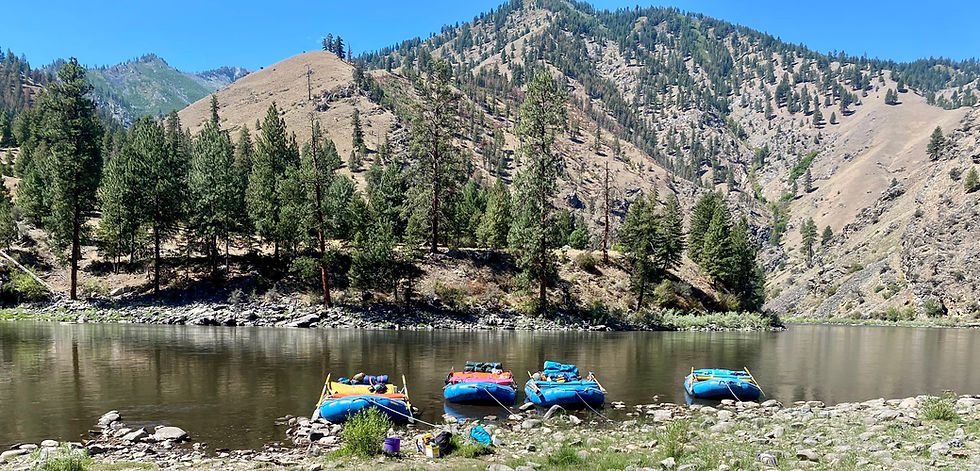
Image by: Alisha Drinkwater. Launching on the Salmon River, Idaho. August 11, 2023.
The guides didn't know what they would be seeing, but they knew things would have changed from the previous 2 decades of rafting. The major Moose River Wildfire and the actively burning 2023 Elkhorn Fire had changed the landscape since their last passage of the Salmon River. There is no way to not see the change, it was blackened and bare. Landmark trees gone. Baren earth open to future rain waters and drought, guaranteeing more degradation to come.
As we found and passed through the wildfire locations, the rafting guides were devastated by the destruction they were laying witness to. The charcoal remains of hillsides that once looked familiar were deeply scarred some embers smoldering visibly.

Image by: Alisha Drinkwater. Salmon River, Idaho Aug 2023, Team Embrace.
Given the severity of our surroundings, the knowledge that our world was on fire and would never be the same was generally known. We didn't know things could get worse. Or did we?
WHAT SALMON ARE ON THE SALMON RIVER?
The rafting journey had many opportunities for considering life and humans and the disparity between the wilderness and how humans live. There was a Sequoia grove of 100's years old trees, the furthest extent where this type is found. There was natural hot spring fed pools to cleanse and purify our physical body's down to the core. Every night, the tents we individually set up each time, there was hovering buzz of wildness and the possibility of wildlife encounters threatening our comfort.
As an environmental biologist in Canada, my curiosity propels me to ask questions. We were on the Salmon River. Being from British Columbia, I know that when a place name speaks so directly to what its characteristics are, the Salmon River must have been chalked full of salmon to inherit this name. I didn't see any fish jumping on this float. Out of season perhaps? Where were they? I know the struggles of salmon. I know the salmon aren't here like how they originally were, as Nature intended.
I wondered aloud what kind of salmon had been on this river. The response from the seasoned river guide was less than inspiring. "I don't know".
The lack of salmon on the Salmon River is so normalized that the humans aren't concerned that there are no longer any salmon up in this area. Historically, the river was recognized for its abundance of salmon given its name. No salmon where salmon once existed has consequences to the ecosystem and the humans.

Image by: NOAA, National marine Fisheries Service. https://earthjustice.org/feature/columbia-basin-salmon-peril

Image by: NOAA, National marine Fisheries Service.
BC SALMON, DAMMING OF THE MIGHTY COLUMBIA
In British Columbia area of the Pacific Ocean, there are 5 species of salmon (Chinook, Coho, Chum, Sockeye, Pink). Our wild salmon populations are under direct threat of collapse as has happened in other world fisheries before. We, as humans, rely on salmon as a protein and nutrient source. Historically our Pacific region was/is known for salmon and all facets of natural life can be interconnected back to the abundance of salmon. From feeding the Orcas, wolves, bears, eagles, and humans, the nutrients from salmon extend to the furthest reaches of a watershed into the forests providing a direct correlation of nutrient exchange wherever salmon streams extend.
Biologically salmon is a keystone species. It's not just 1 salmon having that power, it’s the entire returns of the salmon all together and over time. The massive amount of nutrient enrichment is felt by the entire watershed down to the bottom reaches of the system. The salmon nutrients extend through the food chain through many tropic levels including the vertebrates (wolves, bears, eagles, humans), invertebrates up through the forest floor. Salmon builds the foundation of strength for bones of the forest.
What happens to the nutrient exchange when the salmon stop coming to a stream? Depletion. Peril. Great suffering.

Image by: Screengrab from Bringing Home the Salmon documentary, 2024. Route of salmon into the upper Columbia area that has been disrupted by dams and other anthropogenic influences on the lower portions of the watershed.
The problem came for salmon when our settlers came to North America / Turtle Island and sought to exploit and industrialize processes. Salmon seemed like it was in such abundance that the supply would never stop, why not industrialize this resource and exploit its riches? (As humans, this is our impulse. Its within our restraint as modern humans that we pause and reflect the best solutions going forward, and look back at those previous choices still needing reconciliation (away from harmful outcomes).)
The problem came when settlers settled in flood plains and natural water flow needed to become managed.
The problem came when dams began to exchange hydroelectric power needs with the life cycle needs of salmon and other migratory biota in the ecosystem.
After these problems came for the salmon, mostly everything went silent and more grey. More stripped of its nutrients. More prone to forest fires.

Image by: Alisha Drinkwater. Lulu West Coast Lifestyle.
Reminders of Intentional Fulfilled Living! On the Lewis and Clark trail 2023.
ORIGINAL PEOPLES OF THE UPPER COLUMBIA
The upper Columbia region is where Canadian headwaters of the Columbia river watershed start. For millennia, indigenous lives have been deeply interconnected with the salmon in the upper Columbia area. These included places of coming together (Kettle Falls, Columbia River) to share the resources amongst Tribes in celebration of Nature's bounty. (Oral history by Dan Wilson, Sylix Okanagan Nation. Bringing Home the Salmon, 2024). Removing the salmon from this ecosystem has had dire impacts to those indigenous populations through loss of sharing of their culture and ways of knowing with the future 7 generations.
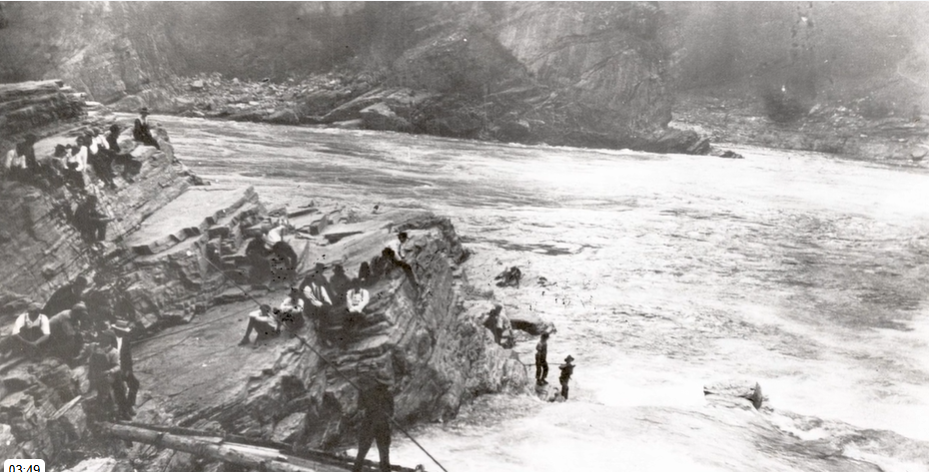
Image by: Screengrab from Bringing Home the Salmon documentary, 2024. A meeting place for Indigenous fishers on the banks of the Columbia River.
At the time that the salmon stopped coming to the upper Columbia River, the hydro company felt it adequate to offer those indigenous communities affected by the loss of salmon, Spam. The quality of Spam as a food staple over time cannot be without health effects. You cannot replace a culture built around salmon with a canned human made food product. Salmon is a fantastic all-in-one nutritional food source, it is irreplaceable and must be protected.

Image by: Screengrab from Bringing Home the Salmon documentary, 2024. Indigenous harvesters on the Columbia.

Image by: Screengrab from Bringing Home the Salmon documentary, 2024. Industrialization of salmon resources in the early years.
THE DAMS
On the mainstem of the Columbia River there are 14 major dams with the entire basin containing over 480 dams (274 dams are hydroelectric). Two major U.S. federal dams on the Columbia River — Grand Coulee and Chief Joseph —do not have fish passage at all. Many of the other dams (big and small) do not have fish passage either.
Dams block over 1700 kilometers/1,100 miles of historical salmon habitat in the Upper Columbia, the natal streams of many distinct and threatened salmon populations. Directly juxtaposed with the needs of salmon to migrate to the top extents of the watershed is the trade off for human power consumption. The largest producer of power in the U.S. is the Columbia River's Grand Coulee Dam generating 6,809 megawatts for many wonderful humans depending on the power.

Image from: Portland District Visual Information, U.S. Army Corps of Engineers, 2010 https://commons.wikimedia.org/wiki/File:Pacific_Northwest_River_System.png Green highlight demarking the Salmon River, Idaho added to show the preceding dam structures. #LuluWCLifestyle.
THE IMPACT TO SALMON
[Bringing Home the Salmon documentary, 2024: "For thousands of years, millions of salmon returned every year to the upper Columbia River. Then one day in 1939 the Salmon stopped coming home to the upper Columbia region. 'The reason there's no longer salmon in the upper Columbia is because of dams constructed for flood control and power production on the US side and in Canada. Grand Coulee was the nail in the coffin. In the 1930s when they put in the Grand Coulee and that is what stopped the salmon from coming into Canada'".
Every day, every year since the 1930's onward, every salmon migration season, every distinct salmon population would have abutted these structures and been affected by continual human infrastructure interference on their path. The salmon have either figured out a way to pass through a fish ladder, or pass somehow with no fish ladder, or get they get stuck. This creates huge aggregations of migrating fish stuck just below a dam forced to spawn in less than optimal conditions affecting reproductive success. It also creates a dramatic reduction in salmon populations that make it to the other side of the structure, where populations were once full. This struggle continues on every year and will continue until we make a choice to go back and do better.
We need to create legacies that do not offer tradeoffs and leave harmful footprints. Until then, the salmon will continue to try every year to reach their natal streams, the streams they are instinctually programmed to return to, miraculously.
This is why our rafting group didn't see salmon on the Salmon River in Idaho in 2023. There are too many dams in the preceding waters for the salmon to make it through in meaningful populations.
Can we harvest our power in a more reciprocal way, where we leave less of a human footprint? I think we can and we do in some instances. So why aren't we going back to these places we marvel at as feats of human engineering and modifying them to be less impactful on the space they physically occupy? Why wouldn't we? Our lives actually depend on us minimizing our footprints.
But this is where humans get themselves stuck…
We don't like to look backwards and dismantle what once was to make way for refreshened takes on our problems.
Mother Nature is making conditions very challenging and stressful for our salmon too. Elevated river temperatures make egg laying conditions perilous. Humans have not helped the situation with our propensity to exploit resources for our own wants and needs prioritized over nature's needs.
DAMS CHANGING LANDSCAPES
Progression of Grand Coulee Dam before, construction, decades later.

Image by: Google image search. Grand Coulee prior to the dam. Circa 1933.

Image by: Early years of Grand Coulee. Screengrab from Bringing Home the Salmon documentary, 2024.

Image by: Farwestern Photo by Gregg M. Erickson - Own work, CC BY 3.0, https://commons.wikimedia.org/w/index.php?curid=7781908
LEWIS AND CLARK TRAIL
When I mentioned that I went on a conscious journey to regenerate energy rafting the Salmon River in Idaho, I didn't have much of a plan for my exit strategy. Would I go back to Canada through Montana or to head towards the west coast into Portland to visit a good friend?
I chose west for friendships nourishment, then I needed to make my way north, back home to my mother's side. Her time would be coming. How soon, I didn't know.
The gift in this choice was the pathway, an unexpected treat along the Lewis and Clark Trail.
Along the hours long drive westward, my body felt enlivened and rejuvenated. I had been within the wilds of deep Idaho. I felt liberated and back to my centre. But as I drove this nagging ache in my psyche kept going back to being on the Salmon River, the dams, the wildfires, the heating climate making it hard for the salmon to breed, let alone breath, let alone exist.
There were signs: The Columbia River. This was it, the mighty Columbia that I'd heard the biggest of tales. I was here, along its thundering banks. I was getting closer to its mouth. What whispers would it share with me?
This is the same route the early American explorers took in much different times when industrialized humans didn't exist yet, with no whispers of the starkness in the landscape to come. Even through all the human interference and industrialization through the area, I could see (maybe) what beauty those eyes described in 1805 grammatical detail. The dry landscape with deeply carved hillsides showing their wear from the rains of years before. The mighty waters below. Rapids, as noted by Clark during his expedition, enter at your own risk.
Clark from Lewis and Clark expedition, October 21, 1805:
From the site of John Day Rapids, today the site of the John Day Dam.
"... imediately above & below this little river comences a rapid which is crouded with large rocks in every direction, the pasage both crooked and dificuelt, we halted at a Lodge to examine those noumerous Islands of rock which apd. to extend maney miles below ... after passing this rapid which we accomplished without loss; winding through between the hugh rocks for about 2 miles ..."
I stopped along the highway, at a dam called John Day. I parked my SUV on a small road with enough space to safely park and take a look around. Putting the vehicle into park, I swung the door open, a smile began to emerge from my mouth at this new scented air and change in topography, dry and hilly. I round the backside of the vehicle and the span of the mighty John Day dam comes into full view. Without hesitation the audible, spoken words from my mouth, no one there to hear: "Why is the fish ladder so small?" as I look around.
My honest reflection in a moment of taking things in for what they are.

Image by: Alisha Drinkwater. How many human generated systems can you count in this picture? www.LuluWCLifestyle.com
I looked around the hillside, the Lewis and Clark Trail is now a major thoroughfare dotted with wind turbines, lined with fencing, power lines and railways. The riverway bisected by continual dams. Major highway.
How did we humans come this far? How did we come to this place in time where we have not gone back through our past and ensured our footprints on this Earth have been restored. How did we get to a place of normalizing industrialization? It never was an ecological choice. It has always had ecological impacts. How is it that humans were able to turn a blind eye to the consequences brought to the environment, the one that all humans require to live?
Such big thoughts at a time of facing my greatest adversary, my mother's coming death.
I visited my friend in Happy Valley, Portland and gained riches of the uncommon kind. A simple band of suns ray's poking through maples. A 100-year-old book, an investment in my own future (Mental Radio: How to get anything you want by Orcella Rexford B.S.). I'm thankful for a few days of reprieve with a good friends' oasis, as I settled back into my own skin, so tenderly and kindly. Love and laughter and puppy dog tails filled her home.
But now, I needed to orient my travels northward. My mother needed my hand. She loved how I fluffed her pillow at night, making it just right for an amazing night's sleep.
THE FINALE into that dark night…
On the evening of Feb 13th, 2024, it was a beautiful evening with a crescent moon outside the Vernon Jubilee Hospital in British Columbia. The air was crisp, the sky very dark, stars poking through. My mother had her own room on the top floor. Penthouse suite! She finally had her room with a view. She was lying in a hospital bed and wasn't able to speak anymore. She was smiling. My mother gave a thumbs up to the night shift doctor doing his rounds.
Thumbs up as she went into that dark night.
The gesture of this woman so ailing yet in her fullest power. Her dying hours, how can that be in her body’s frailest moments? It just is. So, we accept it, and hold the space for beautiful things to occur, not knowing fully what they even are.
My niece, Netanya, and I were going to take care of my mom for a few hours while my dad took their Great Pyrenees dog, Echo, back to the house on the other side of Okanagan Lake. We sang to her. We gently swayed her, enveloped in a blanket, lightening her load. My dad would only get a couple hours rest before I had to call him back. My mom was passing. He needed to come back. Now.
You see there was preparation into that moment of Now. I knew this evening would be coming. My consciousness had been preparing for it. So, in an intentional effort to rest my aching soul on the Salmon River in 2023, I soul searched and recovered. I prepared for the Now.
Nature's way is miraculous and unrelenting with its own set of rules and playbooks, one that follows the lanes of evolution, populations, behaviour and biology. There is great hope for all Homo sapiens in this truth.
If you are lucky enough, to hold your mother's hand as she enters her dark night, I ask you to breathe deeply, stay steady and hold the space for beautiful things to occur.
Maybe my only purpose on this planet was to hold my mother's hand as she passed. Maybe my purpose was to become a mother, myself. Maybe my purpose was something about Nature or nothing at all. But really, maybe my purpose has a part in lending an honest reflection when I feel we can do better.
No one has all the answers. But many of us hold many clues to better ways of living. It's up to us to be curious what that is, what that feels like, what that looks like and make a commitment to invest in our best version for our own futures.
Be the change because you and the lineages that come from you deserve to live in beauty. It's necessary for our survival in 2026 and beyond.
Lulu West Coast Lifestyle
Living Life Beautifully, Conscientiously!
POSTSCRIPT
October 2024, Pacific Salmon Foundation EVENT - GRANVILLE ISLAND

Image by: Alisha Drinkwater. 2024. Pacific Salmon Foundation film screening of Bringing the Salmon Home at Granville Island, BC.
The fall after my mother's passing, October 2024, the Pacific Salmon Foundation held a live screening of the documentary Bringing Home the Salmon at the Waterfront Theatre on Granville Island. (Thank you to my dear friend Angela who knew I would have an interest in being her plus 1).
The documentary highlighted an indigenous led salmon restoration project on the Upper Columbia watershed. The story told through this documentary touched my humanity and love of life very deeply. After the film screening, a Panel of indigenous youth and others were pulled together to share and respond to questions. I felt an inner pull to share my story, to share my experience on the Columbia River watershed.
Raising my nervous hand, it felt like no blood wanted to remain with in my arm. A person brings me a microphone. I take a sighing breath before I speak. I started by sharing that I was very uncomfortable speaking in front of people, that I've had anxiety since I was a child, but I feel it's important to share my experiences on the Columbia River watershed with the panel and the audience. I told them about being on the Salmon River the previous year with no salmon. I told them about turning westward and being on the anthropogenized Lewis and Clark Trail. I told them about the John Day dam and asking, "why is the fish ladder so small?". I shared with them my pain of laying witness to all that we, humans, continue to do to our mother earth. I asked one question to the indigenous youth and the Panel, "How do we go from here? You've shared this story about the dire impacts of damming on the Columbia River and its legacy of lack. And in this year, we continue to proceed in such ways with the flooding of the Peace River to create the Site C dam. We continue to proceed down those pre-existing pathways that are harmful to so much and so many. How do we go from here? Where we have the information but we continue to proceed ultimately harming ourselves. How do we go from here in a Now society?"
I was so flooded with stress endorphins that I really don't recall their response. I did feel a collective sigh from the audience though, like I had spoken something that hadn't been spoken out loud by the collective yet. A relief of some kind that having my lens present and able to speak the truth of what I've laid witness to being shared outwardly and freely. It wasn't about the question having a reply that would fix the problem. It was about sharing of an impactful experience with a full theatre of humans that have the potential to change the future of our world.
We cannot turn a blind eye to what we don't want to see anymore. The runway for that lifestyle has run out. It’s time to come back to ourselves deeply and attune to our natural human abilities to do better and let go of whatever it is that we hold onto so tightly. That was the past. We don't have to go that way anymore. It wasn't okay. It wasn't sufficient. It was not in harmony.
We look backwards and marvel at what we have done. We give ourselves pats on the back and accolades. We continue to wear our man-made lenses which perpetuate our orientation towards humans being the 'best', being 'right' and having cart blanche to act on our will.
Where is the space for restraint? Where is the space for equal opportunity for harmony? When you pull your vision into what you think is 'right' it's hard to see the spectrum of options and opportunities before you. This is just fact.
When humans choose to wear these slanted lenses we become very narrow focused, short term oriented. Profits over paradise.
Forgive our ancestors and those that came before us. They did what they knew or they thought necessary. Reconcile that. Move forward. We need to make things 'right' with the environment. We cannot behave in these ways that leave consequential legacies for our future beings anymore.
At this time at 2026, we can look backward at what has happened, create the space for better decision making, and then move in a new way that includes everyone and every being. We need to get to the starting point that we are Homo sapiens doing this life together.
CALL TO ACTION:
Support a local environmental non-government organization (don't know of one? How about Comox Valley Project Watershed Society - Project Watershed)
Support local indigenous water and land guardian programs (don't know your local indigenous brothers and sisters? Introduce yourself. Learn about the tribes that lived and thrived on the land prior to settlers arrivals. These people carry oral teachings that are a gift for us today and our future about how to survive and thrive on Turtle Island).
Support long term funding to protect the sensitive resources of your local area. (waterways, forests, wetlands).
Become involved in whatever empowers you to become your best version. Make it part of your #ModernLifestyle.
Support my Art www.luluwclifestyle.com/shop
I've written this article in reciprocation to attend TFSX ALIVE in Asheville, NC April 23-25, 2026. I've written this freely of my own lens and reflection from my experiences of the Columbia River watershed. I'm sharing this story as a gift to the Dragonfly Project. May the seeds that we sew today, grow, thrive and bloom their own seeds unfettered into our shared future.
Want to join in the conversation? Join me in Ashville, North Carolina.

www.luluWCLifestyle.com/blog Living Life Beautifully, Conscientiously!
Further reading and exploration:
How a federal agency is contributing to salmon’s decline in the Northwest - OPB
Film: Bringing Home the Salmon https://vimeo.com/822794112 ; Film Trailer: Bringing the Salmon Home - 2024 Trailer
September 2025 CRSRI UPDATE - 2 introduced salmon returned to the Upper Columbia!
The Columbia River Salmon Reintroduction Initiative (CRSRI) on the Upper Columbia shared that Salmon have been returning from 2023 releases from the ocean. They shared the salmon return was documented to Wells dam and Rocky Reach with no detections after that point.
"two tagged sockeye salmon that were released in the upper Columbia as juvenile fry in 2023 were detected returning into the Columbia River as adults in the summer of 2025. The fish completed a remarkable journey down through a dozen major dams to the ocean and back toward their ancestral waters."

For further interest on other biota affected by damming, watch this infographic on the American Eel and the St. Lawerence Seaway. Sarga — CarolAnne Black
Personal Wildfire experience:
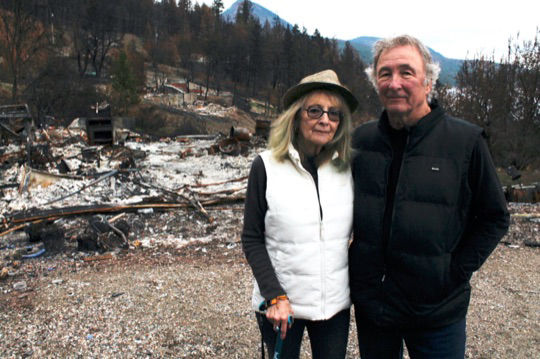
2021, My parents standing in front of the remnants of their home in the Okanagan, BC.
Image from: ‘Everything Is Burning and Your House Is Gone’ | The Tyee
"Elaine and Bill Drinkwater stand in front of the remains of their garage. Their three-storey house used to stand behind them, surrounded by Elaine’s ‘Garden of Eden.’ The Drinkwaters’ home burnt down at the same time they lost their niece to cancer, and learned of Elaine’s sister’s Stage 4 cancer diagnosis. Photo by Michelle Gamage"
NOTE: my mother was misquoted here. She had ALS-Like diagnosis, a degenerative neurological disease (she did not have cancer).


Comments